Tower vs box vs pedestal fans: which actually moves the most air
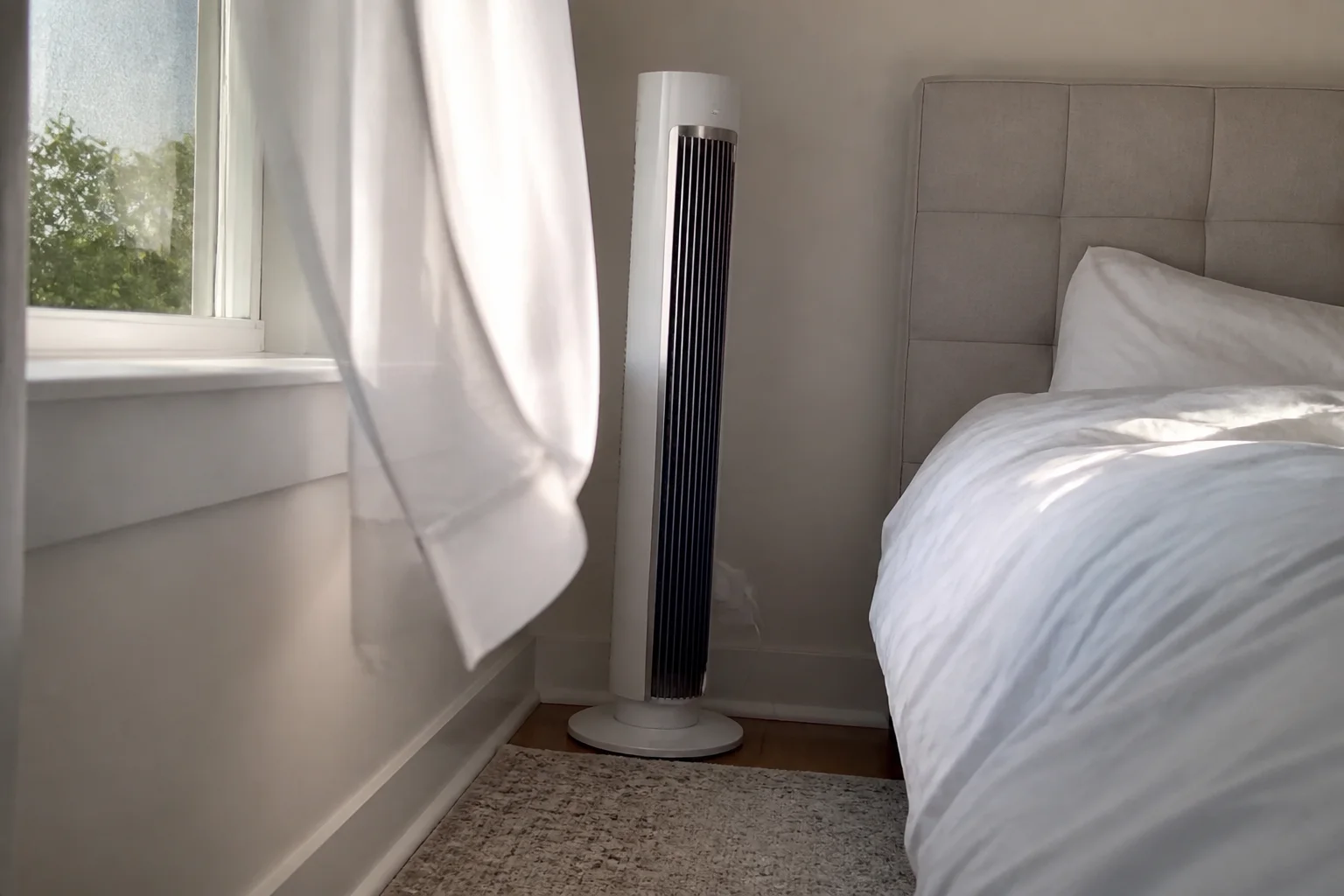
What the extra money actually buys is quiet, looks and features — sometimes worth it, rarely said out loud.
In this article:
- Airflow per dollar: the rankings nobody prints
- Night noise: the spec that decides bedrooms
- The window trick that beats any single fan
- Buying notes by type
- Key takeaways
- FAQ
Airflow per dollar: the rankings nobody prints
Raw air-moving (CFM): box fans and pedestal fans lead by a wide margin — big blades move big air. Tower fans' tall-thin design is aerodynamically compromised; most move half the air of a decent box fan. So why do towers dominate shelves? Footprint, looks, quieter low speeds, oscillation, remotes and timers. Legitimate wants — just know you're buying livability, not power. Need maximum cooling? Pedestal or box. Need pleasant background airflow in a bedroom corner? Tower's fine.
Night noise: the spec that decides bedrooms
For sleeping, the number that matters is dB at the speed you'll actually use — many fans are quiet on a useless low and loud on a useful medium. Under ~45dB on a real setting is bedroom-friendly; smooth broadband whoosh beats tonal whine at equal volume (check reviews for 'hum' complaints). Bladeless-style and premium towers genuinely win here — this is the one place their price buys something measurable. White-noise fans double as sleep machines; that's a feature, not a flaw.
The window trick that beats any single fan
One fan blowing at you moves comfort; two fans managing air exchange cool the whole house. On summer evenings when outside turns cooler than inside: one fan exhausting hot air out an upstairs/leeward window, another pulling cool air in from the opposite side — a poor man's whole-house fan that drops indoor temps for pennies. A box fan's flat shape sits in a window frame like it was designed for it, because it basically was.
Buying notes by type
- Box: peak air per dollar, window-friendly; loud-ish, zero features.
- Pedestal: box-fan air with height adjust and oscillation — the room workhorse; check for a quiet-low.
- Tower: footprint, remote, timer, gentler sound; accept the airflow discount.
- Air-circulator style: small, focused beam for pointing across a room — surprising reach, desk-and-corner champion.
- DC-motor models cost more, sip power and offer many quiet speeds — worth it for all-night bedroom duty.
Key takeaways
- Box/pedestal fans win raw airflow per dollar; towers sell footprint and quiet.
- For bedrooms, judge dB at your real speed — under ~45dB, smooth not whiny.
- Two fans doing in-and-out air exchange beat one fan blowing at you.
- DC-motor fans earn their premium on all-night quiet and power sipping.
FAQ
Do tower fans work as well as box fans?
On air moved, generally no — half is typical. They win on looks, footprint, features and low-speed quiet, which is an honest trade if you know you're making it.
What fan is best for sleeping?
A DC-motor tower or circulator rated under ~45dB at a mid setting, with a smooth sound signature. Timers and 'sleep' ramps are nice extras.
Can fans actually cool a room?
Fans cool people (evaporation), not rooms — except the two-window exchange trick when it's cooler outside, which genuinely lowers room temperature.
Are expensive bladeless fans worth it?
They're quiet, safe around kids and lovely objects — you pay several boxes-fans-worth for those qualities. Airflow-wise, physics still favors big cheap blades.
Keep reading
Portable AC vs Window AC: The Honest Efficiency Truth →Space Heaters: Safety Rules and What They Really Cost to Run →
Not sure which one to buy?
Vic's benches: real Amazon & Walmart listings, live prices, honest verdicts.
Ask Vic →