Portable vs window AC: the honest truth about which cools better
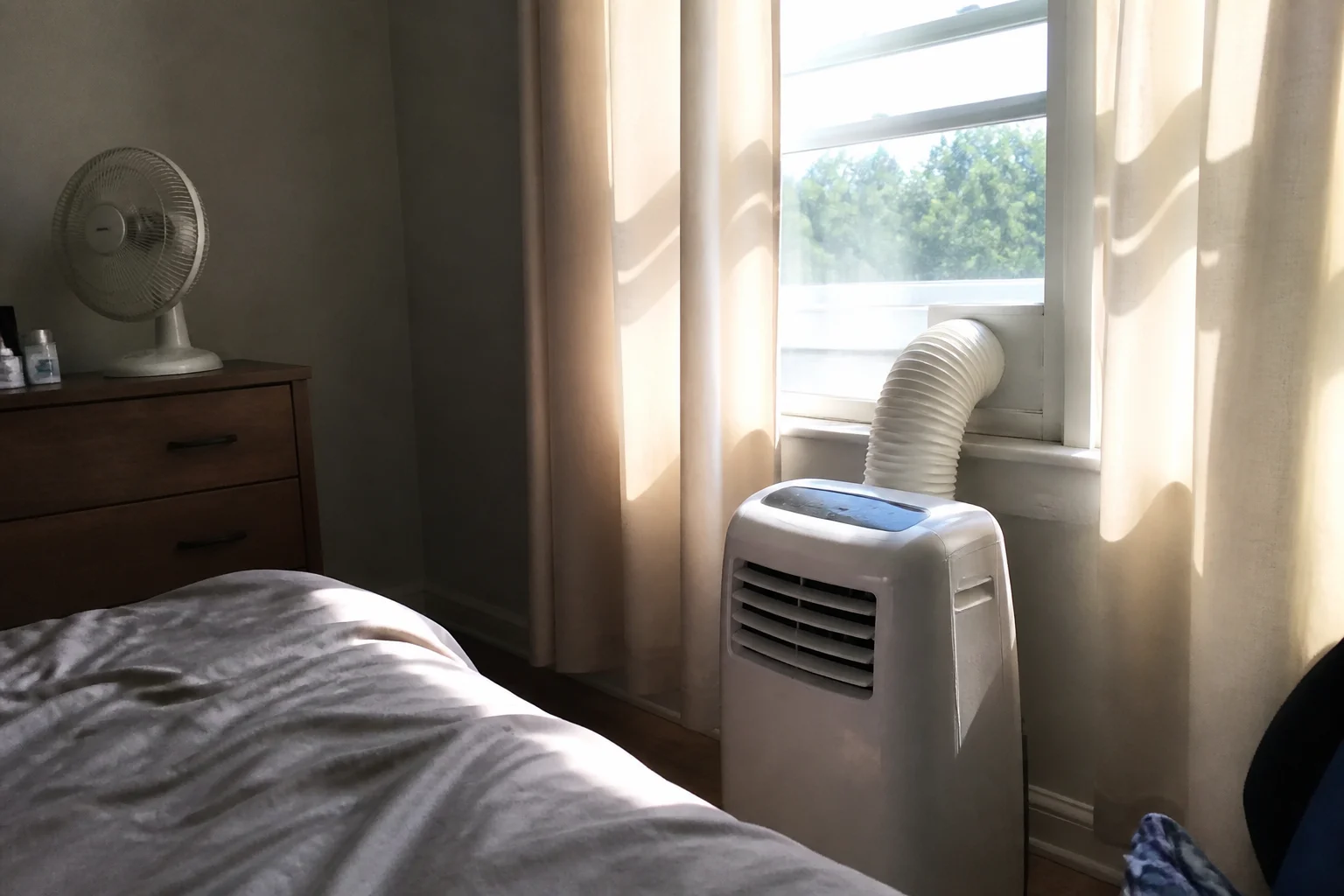
Here's the sentence AC marketing won't print: a window unit cools roughly twice as well per dollar as a portable. Portables exist for rooms where the window unit can't — and if that's your room, there's a right way to buy one.
In this article:
- Why portables lose on physics
- If it must be a portable: dual-hose or bust
- Sizing without the sales math
- Install and running truths
- Key takeaways
- FAQ
Why portables lose on physics
A window unit hangs the hot half of itself outside. A portable sits entirely in your room, pumping heat out through a hose — while the machine's own heat leaks back in, and (in single-hose designs) while it blows your cooled air outside and sucks hot outdoor air in through every gap to replace it. That's why the honest ratings dropped: the new SACC standard shows portables delivering 50–70% of their old advertised BTUs. Same money, window unit, colder room — every time it's possible.
If it must be a portable: dual-hose or bust
Dual-hose portables draw outside air to cool the machine and exhaust it back out — no vacuum effect stealing your cooled air. They cool meaningfully faster and more efficiently than single-hose, for modestly more money. The other non-negotiable: read the SACC rating (the honest number), not the legacy BTU headline. A '14,000 BTU' single-hose delivering 8,000 SACC is the category's most common disappointment.
Sizing without the sales math
| Room | SACC needed |
|---|---|
| Up to 200 sq ft (bedroom) | ~6,000 |
| 200–350 sq ft | 7,000–8,500 |
| 350–550 sq ft (open living) | 9,000–12,000 |
Add ~20% for sun-baked rooms, kitchens or high ceilings. Undersizing is the classic error — a too-small unit runs flat-out forever, humid and loud, and never quite arrives.
Install and running truths
Drainage: most modern portables self-evaporate in dry climates but need emptying in humid ones — check the tank size if you're in the sticky half of the country. Noise: portables put the whole compressor in your room; check decibel specs (under 52dB for bedrooms) because 'white noise' and 'small engine' are different sleep experiences.
Key takeaways
- Window units cool ~2× better per dollar — portables are for rooms that forbid them.
- Buying portable: dual-hose design and the honest SACC rating are the two non-negotiables.
- Size by SACC to the table above and add 20% for sun and kitchens.
- Seal the window kit with foam tape and check dB ratings before bedroom duty.
FAQ
Why is my portable AC not cooling the room?
Usually single-hose physics (it's pulling hot air in around doors), a leaky window panel, or an SACC far below the marketing BTU. Sealing gaps helps; the architecture is the ceiling.
Are portable ACs worth it?
When window units are impossible — casement windows, rental rules, no safe mounting — a right-sized dual-hose portable is genuinely effective. As a free choice against a window unit, no.
Do portable ACs need draining?
In humid climates, yes — tank sizes and auto-shutoff matter. Dry climates: most self-evaporate through the exhaust and rarely need it.
How many BTUs do I need?
Ignore legacy BTUs; use SACC: roughly 6,000 for a bedroom, 8,000 for a mid room, 10,000+ for open spaces — plus 20% for sun-soaked rooms.
Keep reading
Dehumidifier Sizing: What Pint Rating Your Space Needs →Tower Fan vs Box Fan vs Pedestal: Which Moves Air Best? →
Not sure which one to buy?
Vic's benches: real Amazon & Walmart listings, live prices, honest verdicts.
Ask Vic →