Power banks: what mAh really delivers, and the charging-speed trap
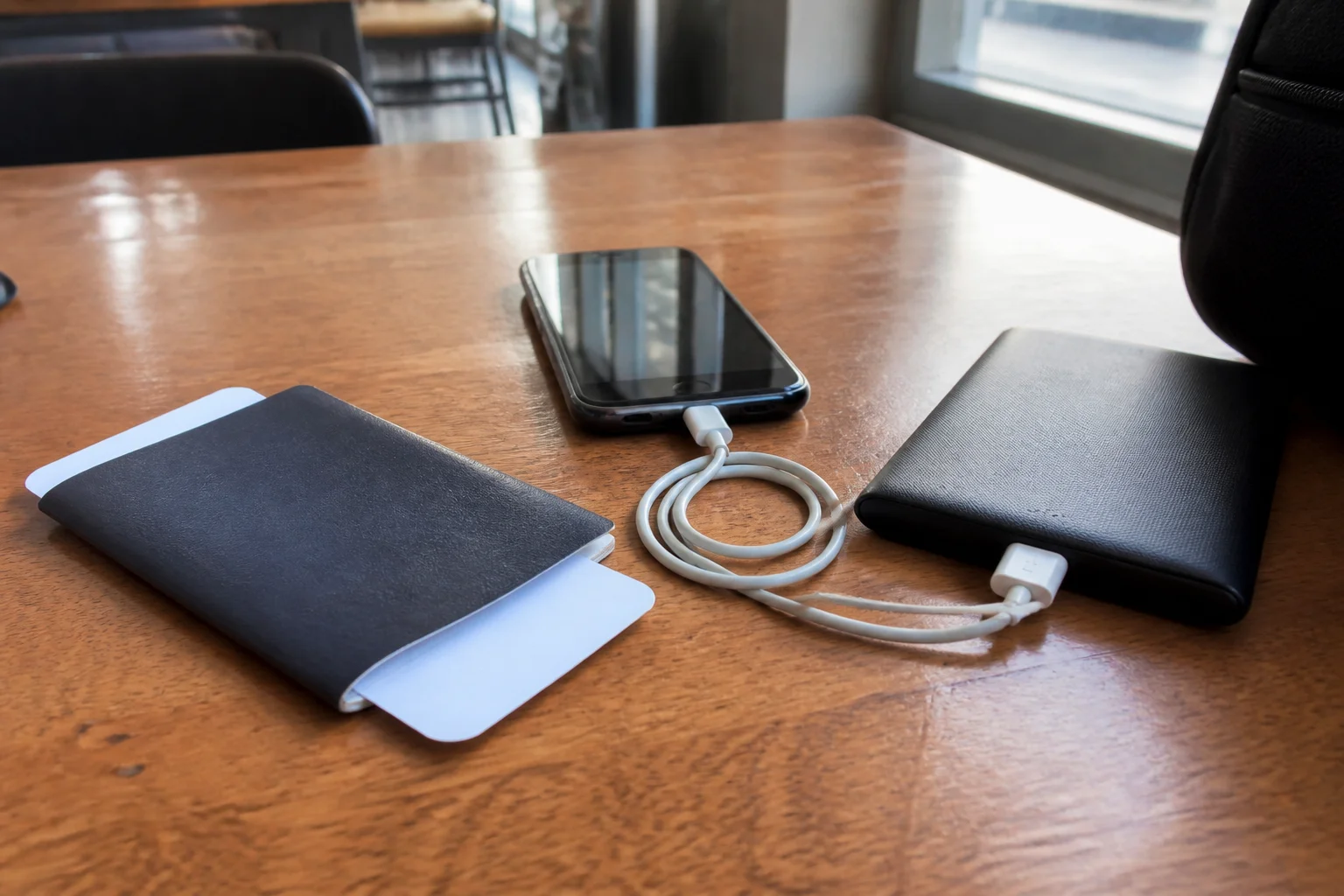
A 10,000mAh power bank does not hold three full phone charges — and the sticker never explains why. Here's the honest math, plus the wattage rules that decide whether your laptop will even sip from it.
In this article:
- The 65% rule
- Sizing by what you actually carry
- Watts decide what it can charge
- The cable is the silent bottleneck
- Key takeaways
- FAQ
The 65% rule
mAh ratings measure the bank's internal cells at 3.7V; charging your phone at 5V+ through conversion circuitry loses roughly a third. Rule of thumb: usable output ≈ rated mAh × 0.65. A 10,000mAh bank delivers ~6,500mAh — about 1.3–1.5 modern phone fills, not the 'three charges' implied. This is physics, not fraud, and it's why the honest sizing chart below counts real fills.
Sizing by what you actually carry
| Bank | Real fills (phone) | Best for |
|---|---|---|
| 5,000mAh | ~0.7–1 | pocket emergency top-up |
| 10,000mAh | ~1.3–1.5 | the everyday sweet spot |
| 20,000mAh | ~2.5–3 | weekends, two devices, tablets |
| 25,000mAh+ | 3.5+ | trips, laptops — mind the flight rule |
The flight rule: batteries fly carry-on only, and airlines cap them at 100Wh without approval — that's ~27,000mAh. The big 30,000+ banks marketed for travel can be exactly the ones a gate agent pulls.
Watts decide what it can charge
Capacity says how much; wattage says what. Phones fast-charge at 18–30W. Tablets want 30W+. Laptops need 60–100W USB-C PD — a 20W bank plugged into a laptop either trickles or does nothing. If laptop-charging is the goal, buy a bank explicitly rated 65W+ with Power Delivery, and remember the output splits when two devices share it. Pass-through charging (bank charges while charging your phone overnight) is a quietly essential travel feature — check for it.
The cable is the silent bottleneck
A 100W bank through a cheap cable delivers whatever the cable tolerates — often 15W. High-wattage charging needs cables rated for it (60W+ needs an e-marked USB-C cable for 100W). If your 'fast' setup charges slowly, the free cable in the junk drawer is the usual suspect. Buy one good rated cable and label it like it matters — it does.
Key takeaways
- Usable output ≈ rated mAh × 0.65 — a 10,000 bank is ~1.4 phone fills.
- 10,000mAh for daily carry, 20,000 for weekends; 27,000mAh is the flight ceiling.
- Laptops need 60W+ USB-C PD banks — capacity without wattage charges nothing.
- Cheap cables silently cap fast charging; one rated cable fixes the mystery.
FAQ
Why does my 10,000mAh bank only charge my phone once?
Voltage conversion eats ~35%, and modern phone batteries are big (4,500–5,000mAh). ~1.3 fills is the honest expectation, not a defect.
Can I take a power bank on a plane?
Carry-on only, never checked. Under 100Wh (~27,000mAh) is fine on essentially all airlines; bigger needs airline approval or stays home.
Can a power bank charge a laptop?
Only with 60W+ USB-C Power Delivery output (100W for larger laptops) — check the laptop's charger wattage and match it. Standard phone banks won't do it.
Why is my power bank charging slowly?
In order of likelihood: the cable isn't rated for the wattage, the port you picked is the slow one (banks often have one fast port), or the bank itself is nearly empty and throttling.
Keep reading
Portable Power Stations: How Many Watts You Actually Need →Wireless Chargers: Speeds, Qi2 and What Slows Them Down →
Not sure which one to buy?
Vic's benches: real Amazon & Walmart listings, live prices, honest verdicts.
Ask Vic →