Hair dryer buying guide: ionic, ceramic, and why watts lie
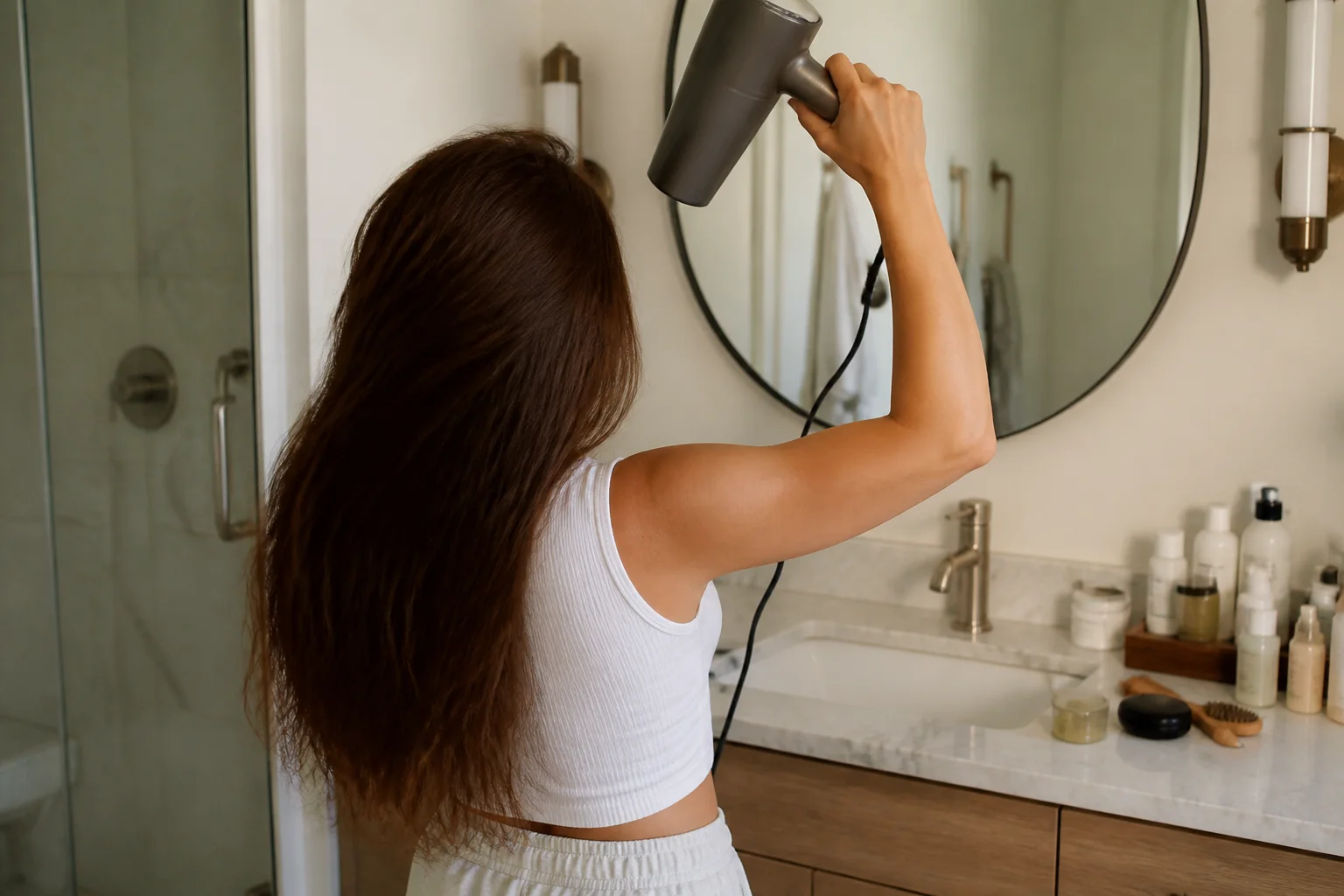
The premium dryer revolution proved one thing: drying technology matters. What the marketing hides is which parts matter for your hair — here's the honest map.
In this article:
- Watts are the wrong number
- Ionic, ceramic, tourmaline — decoded
- Heat damage: the settings nobody uses
- What to buy by hair type
- Key takeaways
- FAQ
Watts are the wrong number
1875W appears on practically every US dryer — it's a plug-limit convention, not a performance spec. What separates a 12-minute dry from a 6-minute one is airflow (the motor and fan design) and heat control. The premium dryers' real trick is a small high-RPM motor pushing enormous airflow at moderate heat — drying with wind, not cooking. When comparing, look for airflow claims (CFM) and reviews that time an actual dry, and ignore the wattage line entirely.
Ionic, ceramic, tourmaline — decoded
Ionic: negative ions break up water droplets — faster drying, less frizz, genuinely real for thick and frizz-prone hair; can leave fine hair flat (buy switchable ionic if that's you). Ceramic/tourmaline: materials that smooth out hot spots so heat is even instead of scorching — the quiet damage-prevention feature. These aren't rival technologies; good dryers combine them. The marketing treats them as magic; they're just 'even heat, charged air.'
Heat damage: the settings nobody uses
The damage equation is heat × time. High heat + high airflow finishes fast; high heat + weak airflow cooks hair slowly — the worst combination, and exactly what cheap dryers do. Use the highest airflow with medium heat, and finish with the cool-shot button — it sets the style and closes the cuticle, and stylists rate it the most underused feature on every dryer. Concentrator nozzle for smoothing, diffuser for curls: the attachments are half the product.
What to buy by hair type
- Thick/long/frizz-prone: high-airflow ionic — this is where premium dryers genuinely halve drying time.
- Fine/flat: mid-range with switchable ionic and real heat control; low-medium heat always.
- Curly: whatever you buy, the diffuser quality decides the result.
- Budget truth:
Key takeaways
- Ignore watts — airflow and even heat decide drying speed and damage.
- Ionic is real for thick/frizzy hair, flattening for fine hair — buy it switchable.
- High airflow + medium heat + cool-shot finish is the damage-free formula.
FAQ
Are expensive hair dryers worth it?
For thick or long hair dried daily — the halved drying time and lower heat are real quality-of-life. For short or occasional drying, a good mid-range hits the same end result.
What does the ionic setting actually do?
Negative ions shatter water droplets and reduce static — faster drying, smoother finish on frizz-prone hair. On fine hair it can kill volume, which is why switchable matters.
Is high heat bad for hair?
Heat × time is what damages. Strong airflow at medium heat dries faster than weak airflow at high heat — and does less damage doing it.
Why use the cool shot button?
Cool air sets the shape you just created and smooths the cuticle for shine. Ten seconds per section at the end — the cheapest styling upgrade there is.
Keep reading
Flat Irons: Plate Materials, Real Temperatures and Damage →Sonic vs Oscillating Electric Toothbrushes: What Dentists See →
Not sure which one to buy?
Vic's benches: real Amazon & Walmart listings, live prices, honest verdicts.
Ask Vic →