Air purifiers: what CADR actually means (and the room-size math)
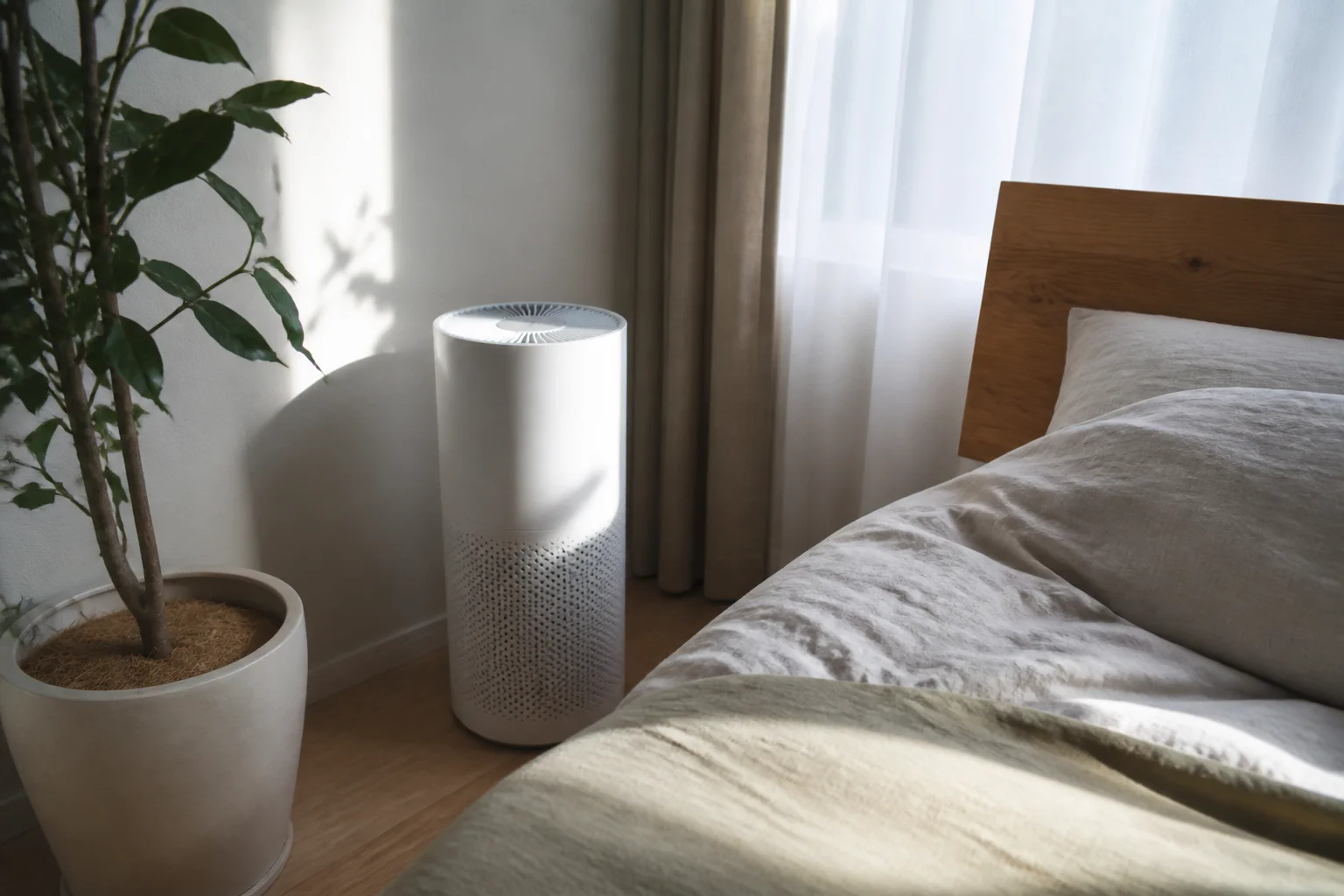
Purifier marketing is a fog of ions, sterilization and 'coverage.' CADR is the one number that can't lie — here's how to read it, and the simple math that matches a purifier to your actual room.
In this article:
- CADR: the number that can't lie
- Why 'covers 1,000 sq ft' claims mislead
- HEPA, 'HEPA-type', and the ionizer question
- The real cost is the filter shelf
- Key takeaways
- FAQ
CADR: the number that can't lie
Clean Air Delivery Rate measures cubic feet of cleaned air per minute, independently testable, for smoke, dust and pollen. Marketing can inflate 'coverage area'; it can't inflate CADR. Rule of thumb: your room's square footage × 2/3 = the minimum smoke CADR you want (that delivers roughly five air changes per hour at 8-foot ceilings). A 300 sq ft bedroom wants CADR 200+.
Why 'covers 1,000 sq ft' claims mislead
Those figures usually assume one air change per hour — enough to dilute nothing much. Allergy and smoke relief starts at 4–5 changes per hour. The same machine honestly covers about a fifth of its headline area at that standard. Always convert back through CADR; ignore the coverage number entirely.
HEPA, 'HEPA-type', and the ionizer question
True HEPA (H13) captures 99.97% at the hardest particle size — it's the standard, and it's what the bench requires. 'HEPA-type' or 'HEPA-like' is a lower grade wearing the word. Ionizers and 'plasma' modes add little and some produce trace ozone — if a unit has one, you want an off switch for it. Activated carbon is the one genuinely useful extra: it's the only thing that touches odors and VOCs.
The real cost is the filter shelf
Before buying, check the filter price × your usage. Auto mode with a decent particle sensor also saves filters (and noise) by running hard only when needed.
Key takeaways
- Room sq ft × 2/3 = minimum smoke CADR. Ignore 'coverage' claims entirely.
- True HEPA (H13) or nothing; 'HEPA-type' is a lower grade wearing the word.
- Carbon handles smells; ionizers add little — prefer models that let you turn them off.
- Price the filters before the machine — they're the real five-year cost.
FAQ
What CADR do I need for a bedroom?
A typical 150–250 sq ft bedroom wants smoke CADR 100–170. Round up — running a bigger unit on low is quieter than a small one on high.
Do air purifiers help with allergies?
Yes, measurably, for airborne pollen, dander and dust — with a true HEPA filter, enough CADR for the room, and the door mostly closed. They can't touch allergens already settled in carpet.
Should I run it 24/7?
That's the design intent — auto mode makes it cheap. Power draw on low is 5–15W, pennies a day. Continuous low beats occasional blasts.
Are expensive purifiers quieter?
Usually — bigger fans moving the same air spin slower. Check the low-speed dB rating (under 25dB is bedroom-invisible) rather than the max.
Keep reading
Dehumidifier Sizing: What Pint Rating Your Space Needs →Weighted Blankets: How to Choose the Right Weight →
Not sure which one to buy?
Vic's benches: real Amazon & Walmart listings, live prices, honest verdicts.
Ask Vic →