Projector vs TV for home theater: the honest 2026 answer
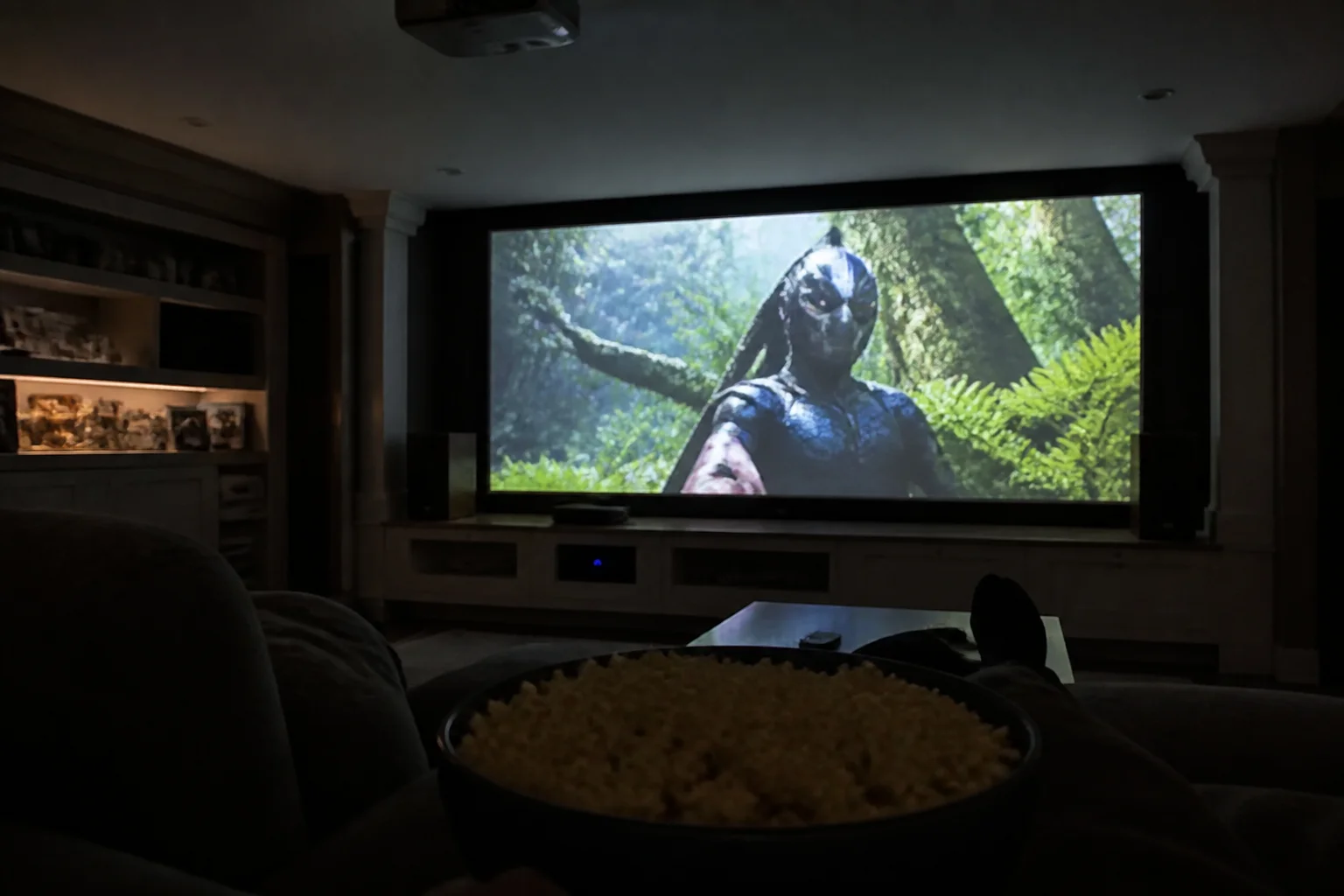
A 100-inch picture for the price of a 65-inch TV sounds unbeatable — until room light enters the chat. Here's when each one genuinely wins.
In this article:
- Light control decides everything
- Where the projector wins outright
- Where the TV wins daily life
- UST and the anti-glare screen middle ground
- Key takeaways
- FAQ
Light control decides everything
TVs make light; projectors bounce it off a wall, competing with every other photon in the room. In a light-controlled room a projector produces a cinema. In a daytime living room, even bright projectors turn washed-out and gray while a TV shrugs. Rule of thumb: if you can't make the room genuinely dark when it matters, the projector will disappoint you.
Where the projector wins outright
Size per dollar has no contest — 100–120 inches of properly dark-room image for the price of a mid 75" TV. For movie nights, sports events and the theater feeling, nothing on a stand competes. Modern laser units also killed the old pain points: 20,000+ hour light sources (no bulb swaps for a decade), quiet fans, instant-ish startup.
Where the TV wins daily life
Casual viewing: news over breakfast, background TV, gaming after work — the TV wins on zero setup, full brightness at 2pm, better HDR contrast (projectors can't do true blacks in any lit room), and simpler audio (projectors need a real sound system; their built-ins are an afterthought). As the only screen in the house, the TV is the honest pick for most families.
UST and the anti-glare screen middle ground
Ultra-short-throw laser projectors sit inches from the wall, pair with ambient-light-rejecting (ALR) screens, and produce a watchable 100–120" picture with the lights on — a genuine TV alternative in a bright room. The catch: good UST + ALR screen costs large-TV money, and the top TVs still beat it on HDR punch. It's the pick when 100 inches is the requirement and blackout isn't an option.
Key takeaways
- Room light is the whole decision: dark room → projector shines; bright room → TV.
- Laser projectors killed bulb anxiety — 20,000+ hours, quiet, fast startup.
- As the only screen in the house, the TV wins daily life for most families.
- UST + ALR screen is the bright-room path to 100"+, at big-TV prices.
FAQ
Can you use a projector in a bright room?
Standard projectors: not happily — the image washes toward gray. UST laser models on ALR screens are the exception and genuinely watchable with lights on; that combo is priced like a large premium TV.
Do you need a screen or is a wall fine?
A smooth, truly flat matte white wall gets you 85% of the way. A proper screen adds uniformity and pop, and ALR screens are mandatory for bright-room UST setups.
Are projectors good for gaming?
Modern models with game modes reach input lag fine for casual and single-player play at heroic sizes. Competitive twitch gamers still prefer a fast TV or monitor.
How long do laser projectors last?
20,000–30,000 hours to half brightness — 20 movies a week for a decade. Old-style lamp models still exist at the bottom of the market; the lamp swaps are why the bench mostly skips them.
Keep reading
OLED vs QLED vs Mini-LED: Which TV Tech Is Actually Worth It? →What Size TV Should You Buy? The Distance Chart That Decides →
Not sure which one to buy?
Vic's benches: real Amazon & Walmart listings, live prices, honest verdicts.
Ask Vic →